About us

Thursday, 20 March 2014

Chef Vikram Ganpule: the Chef at the Helm of Hyatt Regency


Chef Vikram Ganpule,the Executive Chef of the 5-star Hyatt Regency in Kolkata is a colossus in world of Indian fine dining. He also loves British fish and chips.


When Chef Vikram visited the UK for the Curry Life Chef Awards, one of his culinary missions was to sample traditional fish and chips. Paradoxically, the best ‘chippy’ in London (allegedly) is down on Brick Lane, the mecca for Bangladeshi and Indian food in the UK. The gourmet chef not only enjoyed his British meal, he wanted to replicate it back home: “The batter is so crisp all the way through and the fish is very moist,” he eulogised. “We’ve tried cooking this in India but we can never get the batter the same.”

It’s typical of Chef Vikram’s approach in that he is always striving to find the perfect way of producing dishes but, judging by the Hyatt Regency’s track record for gourmet cuisine, he has no need to worry about fish and chips. Every day, literally hundreds of breakfasts, pastries, lunches and dinners from Italian, Indian, Pan Asian and European cuisine are created in the hotel’s speciality restaurants and presented to appreciative diners. This amazing feat is in no small part due to the Executive Chef who commands the entire dining operation much like a stalwart captain bestriding the bridge.


Born in Pune and brought up in Delhi, Chef Vikram first realised his “calling” as a chef in his second year at Institute of Hotel Management in Delhi during a six months internship. His career has taken him to different areas of India, and the Middle East, working for companies including ITC. He joined the Hyatt 11 years ago in Goa: “A lovely and sunny place - the south is quiet but the north is a riot,” he remembers fondly. From thence, he moved to Mumbai before finally arriving at Hyatt Regency, Kolkata.

So what's the average day like for the man who oversees the hotel’s three keynote restaurants - Waterside, the Indian Guchhi and Italian La Cucina - as well as commandeering six kitchens, a huge banqueting area, patisserie and 80 chefs?

“Basically I’ve got a great team,” he says with typical modesty. “The kitchen is divided into outlets, which have their own chef de cuisine, sous-chefs and supervisors.  I’ve also got a great number two but our success is also because of the team that backs us up.

“I typically start at around 8am and take a complete round of all the areas, not just the restaurants, the kitchens, but checking all the areas like the receiving areas,  garbage rooms, refrigerators, walk in areas and banqueting rooms and so forth, generally getting a feel of what’s going on,” he continues. “At around 8.45-9am I meet a few guests if they are having breakfast – long stay or VIPs. Then I switch on my computer and start checking my emails, catching up with correspondence. It’s great with my Blackberry because I used to get restless sitting in an office too long but now I can keep my finger on the pulse all the time. At 10 ‘clock it is our morning meeting. And then the day just goes by, alternating between the office and checking what’s going on, and then it’s meetings, meetings and meetings – more meetings than I would ever imagine!.” 

“When I was supervisor I always used to look at the executive chef’s office with a sense of awe,” he remembers with a laugh. “I never thought I would be here and now and, although some aspects are not always as exciting as I thought, I’m still living my dream.”

Fortunately Vikram, who is  married and father to a ten-year-old daughter, is still able to put his legendary cooking experience to good use: “I teach the guy a few of the basics which seem to have been forgotten, such as the correct way making sauces and gravies,” he tells us. “There are far too many shortcuts nowadays, especially with Indian food.”

As he’s also responsible for training and recruitment, staff appraisals and planning their future careers, Vikram has to be a man of many talents. “It’s a very creative role,” he says. “With the director of food and beverage I help marketing to design food and beverage promotions, arranging for speciality chefs to come here and so it goes on.

“But it is impossible to do everything on your own and I am lucky to have a really fantastic team here. Otherwise I would be losing the little hair that I have!”


Tuesday, 18 March 2014

Ghosts of the British Raj – a walking tour of Kolkata

Following in the true British tradition of foolhardy, stiff upper lipiness, the Curry Life team went on a walking tour, braving torrential rains, lightning bolts, and murky floods, to immerse ourselves (figuratively speaking) in the history of Kolkata and some of the less well-known buildings of the British Raj.


As we set off in one of Kolkata’s ubiquitous yellow taxis, Ritwik, our excellent guide (or explorer) from Calcutta Walks explained a little about the history of Kolkata in times of the British Raj, and the spirit of Bengal. (Unfortunately, shortly after we disembarked my notebook became a soggy mess, so if my following summary isn’t wholly accurate I apologise – I can only blame my poor memory … and Google!).

Over 200 years ago when Calcutta was the capital of British India, the British attempted to superimpose some kind of order, perhaps not fully appreciating the wonderfully chaotic spirit of the city. They settled mainly in the central area around Dalhousie Square (now BBD Bagh), and began to build on an impressive scale. The result is an intermingling of styles that includes European, classical Greek, Gothic, and Mughal architecture. Today, many of the structures of the British Raj are decaying, crumbling ruins on streets haunted by the ghosts of a bygone age, now defunct as a handlebar moustache or a pith helmet.  

But the city is far from decaying along with its buildings. Heading into town Ritwik explained about the character of Bengal. “Bengalis have a reputation for thinking “out of the box”, he told us; “As the Indian leader Gokhale once famously remarked: ‘What Bengal thinks today, India thinks tomorrow’”. Kolkata, as the main city of West Bengal, epitomises that free spirit. Culture plays an important part in the life of inhabitants and it is the home of artists, writers, movie makers, and Nobel Laureates. This was the first city on the subcontinent to have an underground metro. It has the world’s longest-serving democratically elected communist government. It was the place where the first girls’ college was founded in India; also the first newspaper. The Kolkatan-born director Satyajit Ray ranks as one of the world’s foremost filmmakers. Poets and celebrated writers – Tagore, Shankar, Ramakrishna, Vivekananda - are known and read by rich and poor alike, equally proud of their heritage.
 
The High Court of Kolkata
Kolkata also has a vibrant social life. The area around Park Street is a thriving melee of bars, restaurants and neon lights. Life pulsates from every corner. The city and its suburbs are home to around 14.4 million people made up from a melting pot of different cultures and communities including Chinese, Armenian, Jewish, Tibetans, Dutch, European, Marwari and Anglo Indian. Ritwik told us that it is often said that in Kolkata the Orient and the Occident got married. From a casual interloper’s point of view, they seem to live - if not in complete wedded bliss – at least in symbiotic harmony.

Before the onset of relentless crowds and traffic we left the sanctuary of the yellow ambassador taxi to commence the walking part of the tour and sheltered from the monsoon rain under umbrellas on the corner of Raj Bhavan and Curzon Park. Across the road we gazed on Esplanade Mansions, literally a shining beacon of what restoration can achieve. The building is also known as Ezra Mansion after the Jewish family that owned it, until it was taken over by the LIC (Life Insurance Corporation). Built in art nouveau style with semi circular balconies the building resembles a cluster of light houses with dazzling white masonry and turrets.


Splashing through monsoon floods we paused under the wrought iron portico of the currency building (formerly the Reserve Bank of India), where British coins and money were once produced. The ornate iron gates hold the name of the foundry where they were made – a reminder of the 18th century heritage of British wrought iron production. Apparently when ships left India for Britain laden with spices and other exports some sort of ballast was needed for the return journey so the iron was used to weight the ships down, as well as being used in construction. Across the road was the old Telegraph Office, an Italianate building – or more commonly known as the Dead Letters Office. In 1870 when the first telegraph connected Britain to Kolkata, the building served as the central sorting office for incoming mail. If a letter could not be forwarded due to a wrong address or addressee could not be found, it was kept in the office. Many letters still lie there amongst mouldering piles of yellowing papers; their stories of family events, of births and deaths remain, sadly, unread.

Dead Letters Office

Walking past the bus station we came across a one-armed elderly man squatting on the pavement with towers of coins before him. His job was to give out the change to tram conductors. Apparently he has been doing this for fifteen years and, despite the obvious temptation, has miraculously, never once been robbed.

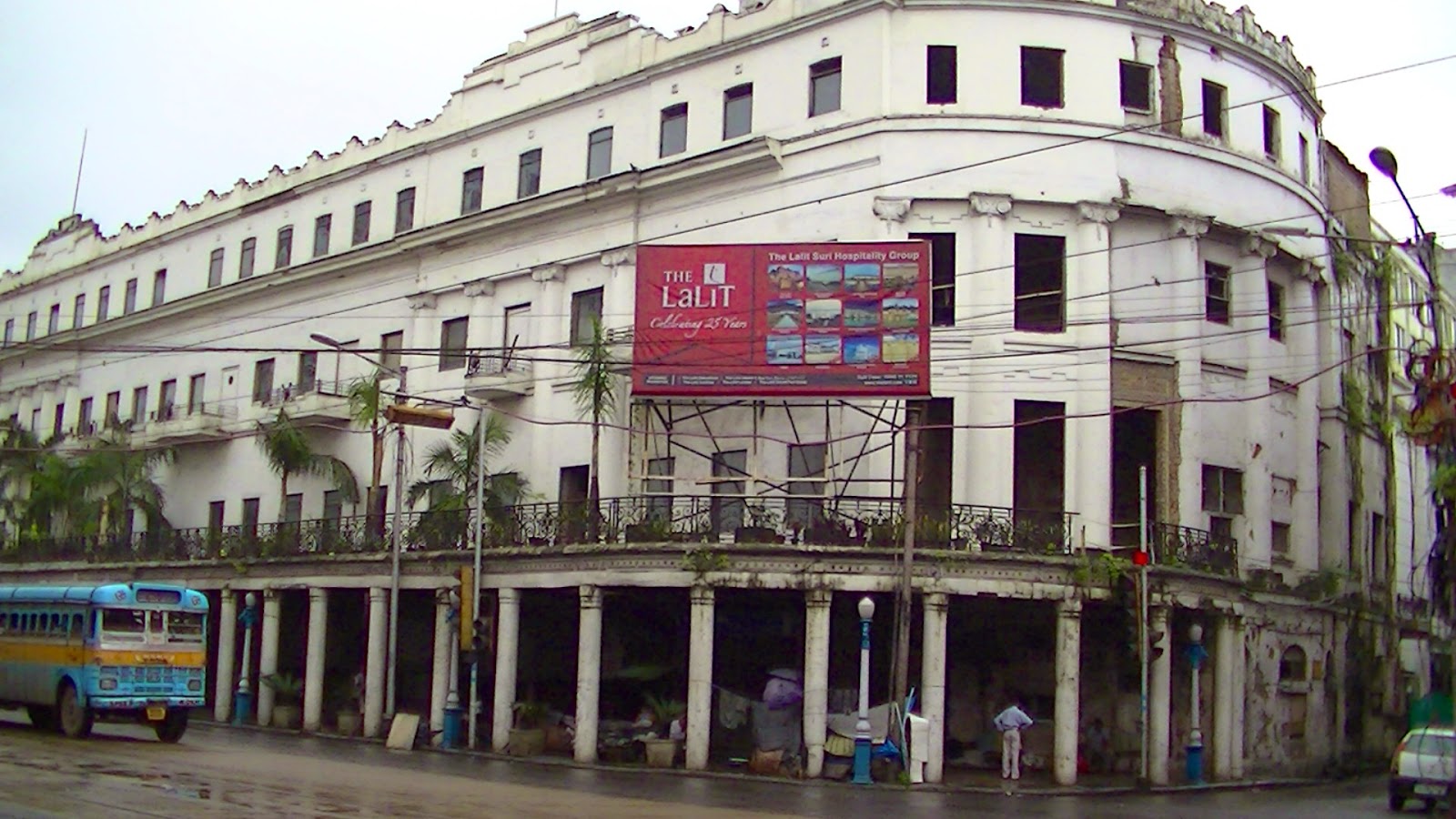
At the crossroads of the Old Courthouse Street and British India Street was the former Great Eastern Hotel, otherwise known as the Auckland Hotel. A building of opulence and luxury, it was founded by a confectioner, David Wilson and described as the “best hotel east of Suez” by Mark Twain on his voyage along the equator. Designed in the art deco style the hotel was the hub of Calcutta’s social life. “The saying about the clientele was that they were “single and ready to mingle,” Ritwick told us. It was the venue for the Maharajah’s New Year parties until the 1950s. Queen Elizabeth 11 stayed there, also Khrushchev. Allegedly the hotel kitchens manned by the legendary Baruas who had migrated from Chittagong (now Bangladesh), to Kolkata, were the talk of the town. Labour union problems caused hotel to go bankrupt and it was taken over by the government in 1975. In November 2005 it was privatised and re-named The LaLit Great Eastern Kolkata. Slow and extensive restoration is now taking place and there are hopes that it will re-open soon.


The former Great Eastern Hotel
A short trip in the taxi took us to BBD Bagh, formerly Dalhousie Square, the heart of the old so-called ‘white town’, and still full of important banks and businesses. The Writers Building originally served as the office for writers of the British East India Company. Designed by Thomas Lyon in 1777 it has a Greco-Roman look and is now used as Chief Minister’s office and Secretariat of West Bengal. Across the square, the grand Old Post Office is one of the most striking buildings of Calcutta with its high dome and Ionic-Corinthian pillars.

Back into the taxi and on the western corner of Raj Bhavan was a familiar, if incongruous, sight: St John’s Church, originally cathedral, was erected by the East India Company in 1784 and was modelled on St Martin-in-the-Fields in London. It’s quite strange to see this quintessentially English landmark uprooted and planted in the steamy environs of Kolkata. Built with a combination of brick and stone, stone was a rare material and came from the ruined city of Gaur in West Bengal and shipped down the Hooghly River.

We paddled through the graveyard (now drenched to the skin), to see the tomb of Job Charnock, the founder of Calcuttta and memorial to the Black Hole of Calcutta. This controversial episode in Indian history took place during the siege of Calcutta when the nawab ruler took 146 prisoners and confined them to a small room. In the morning only 26 were still alive, the others having perished overnight of suffocation and heat stroke. The story goes that one man saved his wife’s life by taking the weight of the press of people himself, thus forming a shield around her. The memorial was erected by John Holwell who was Governor of Bengal originally on the site of the disaster, but it is now widely accepted that the number of people killed in the so-called “hole” was greatly exaggerated and that the deaths that did occur were unintentional; more down to the idiocy of the guards than any murderous intent.

After a short walk, we saw one of the most beautiful buildings in Kolkata, the High Court – the oldest high court building in India. The design is modelled on the Cloth Hall at Ypres, Belgium constructed in 1872 by architect Walter Granville.  Made of red brick with stucco dressings and Barakur sandstone, the structure stands out because of its Gothic style and red colour.
Flury's
Our tour finished at Flury’s, a fashionable art-deco style teahouse where we took tea in a sodden huddle as rain dripped from us and formed puddles on the floor. The tearoom, founded in 1927 was originally owned by Mr Flury and Mr Trinca. It was known and loved by Indians and Europeans alike for its confections and exotic pastries, until unfortunately one day Mr Flury ran away with Mrs Trinca and the partnership came to an abrupt end. But the name lives on. Like Kolkata in its love-hate relationship with the British Raj – one party has left the building, but the other is very much alive - and flourishing.

Our tour was with Calcutta Walks who organise tailor-made tours of Kolkata and beyond.  For further information please visit www.calcuttawalks.com/

Dominic Chapman - Michelin-starred Chef Shines in India


India is home to many magnificent restaurants and chefs but the subcontinent has no equivalent to the sought after Michelin Star.  Curry Life took the Michelin starred chef, Dominic Chapman, to cook his brand of quintessentially British food in Kolkata. Here’s what he made of his experience and (just as important)… what the Indians made of him.

Dominic Chapman, Michelin-crowned chef of the Royal Oak, Paley Street summed up the Taste of Britain Curry Festival in one word: “Amazing!”

“It’s been one of the most incredible weeks I’ve had for a long time,” he told us with boyish enthusiasm over a beer in the Hyatt Regency Hotel in Kolkata.  Dominic had just completed a jam-packed four-day stint at the festival and, in his own words the experience had been “full on”.  As a seasoned traveller he admitted that this first trip to India had been an eye opener. “I feel that I’ve been cheating a bit. “There is no denying it – India is a one hell of a country. If I was out there on my own with my back pack on, without the luxury of being able to afford to stay at the Hyatt I would find it hardcore.  As it is I’ve been able to be involved with the festival here with the opportunity to go out there and sample what’s going on out there. Yes, it’s crazy but you just kind of harness that and go with it. I’ve had an absolute ball.”


 Dominic with festival organiser Nahas Pasha
Dominic is the head chef at The Royal Oak Paley Street in Berkshire and Holyport’s Belgian Arms, but he’s also no stranger to adventure. He spent some years exploring Australia before coming back to the UK and working as chef de partie at Heston Blumenthal’s The Fat Duck, later moving on to take on the role of head chef at The Hinds Head in Bray. In 2007 he moved to The Royal Oak Paley Street, co-owned by TV personality Michael Parkinson, now one of only 13 Michelin star pubs in the UK. It’s perhaps not surprising that Dominic has achieved such incredible culinary success; his family has owned and run the Castle Hotel in Taunton for over 60 years. The passion for cooking is in his blood.

After a chance meeting with Lord Karan Bilimoria, founder of Cobra Beer, Dominic was invited to accompany the Curry Life team to India for the Taste of Britain Curry festival.

Although India is not covered by the Michelin food guide, there is considerable interest in the concept, not least in the idea that a British chef can produce good food. Dominic’s arrival was greeted with a barrage of local and international press and customers who were keen to sample his British classics of Lamb Roast and Fish and Chips. They went down very well! Even allowing for the customary politeness of the Indian people, there were compliments all round, especially for the Lemon Tart which was a sensational success. In fact it was so popular that Chef Vikram Ganpule, Executive Chef at the Hyatt, decided to keep it on the menu.

Dominic with chefs Jamal Uddin and Partha Mittra
Dominic has a huge respect for British curry chefs. “They have an intimate knowledge of spices that leaves me feeling somewhat of a novice,” he said. “The Curry Life chefs and the team of chefs in the kitchens here are very passionate about cooking and they really want to learn. It’s the same if you are a chef in the UK, in India or any other part of the world - you love cooking, you want to learn about cooking and ultimately, to cook great food.”

Does he see many differences to Indian dishes produced in the UK? “The heat of curry in the UK is quite harsh – over there it’s a case of ‘wow that has really blown my head off, have another drink of lager’,” he says. “Over here it’s chilli hot and it warms your mouth but it’s fresh, you can really taste those spices and flavours. But I still enjoy eating curries in the UK because when you’re not sitting in a 5-star hotel, out there, if you don’t know where to go, it can be pretty, pretty rough.”

When Dominic was not having a ball the festival threw up some stiff challenges. Perhaps the hardest of these was producing a 7-course, completely vegan meal for a high powered business man in Kolkata who had heard about his expertise and wanted to test his skills out for himself. Dominic rose to the occasion with customary aplomb. “I challenge any chef to come to India and do the same and not find it difficult. And of course, you want to reach a certain standard; you want your ingredients to be the best. One thing about India is that you have to get your food from the market fresh in the morning, and then cooked for lunch; food does not keep. In the UK, everything is perfect – we get perfect leeks, immaculate aubergines. In this country if you’re not careful spring onions look like chives, cauliflowers may have seen better days and herbs are wilting before they’ve even got to a fridge.

“And there are a few problems with supply. I’ve ordered everything from here; you expect things to arrive in two hours but they’re more likely to arrive in two days. It took four hours for my quail egg to be delivered because of traffic but at the end of the day that’s OK - you have to embrace it and it’s fantastic. The team here has been brilliant and so supportive. And I’ve learned things to take away with me – I’ve been especially impressed by the standard of the breads which are freshly baked here in the Hyatt.”

Talking of the street life he said: “Coming from the UK it makes you realise that we have easy – you really think these guys are so resilient; there is poverty everywhere and yet they’re so smiley. And they all work hard and just get on with their own lives.”


One of Dominic’s main aims on the trip was to go out and embrace the life, country and culture of India, in particular to sample the street food for which Kolkata is justly famous. To that end he was taken on a whirlwind tour of the city by local journalists in search of the origins of British curry. At Collin Street at the home of Rubin and Pamela Ribeiro he was cooked a typical Anglo-Indian meal; “They were a lovely, lovely family,” he enthused. “They made me a mutton curry, yellow rice and red pepper curry. It was brilliant food – the lady took great care in preparing and cooking it and it was delicious.”

Sampling Kolkata’s famous street food, he wasn’t quite as enthusiastic. “It looked good – it was great street food and it looked a million dollars but to be honest with you I was a bit conscientious about tasting it rather than eating it because of hygiene issues.” Nevertheless he pronounced the Phuchka “flavoursome” whilst he described the spicy chickpea stew or gnugni with coriander, onion and tomato as “one hell of a snack”. At Gariahat he ticked off another item on his wishlist - a visit to the famous fish market. “It was like a farmer’s market,” he said. “The produce was fresh and there was such variety. The tent-like structure was typically Calcutta as were the broad flat blades with which they cut the flesh but the people, the chaos and the noise was just like any fresh food market the world over with its own local characters.” From thence he was whisked off to sample the delights of mishti at a 159-year-old sweet shop, all nicely rounded off with a mandatory Darjeeling tea and Rum Ball.

It’s evident that Kolkata made a massive impression on the chef but what did the people of Kolkata make of Dominic? It seems that in the brief time he was there the genuinely enthusiastic and friendly chef left his own indelible mark on the city.

The following day we, ourselves took a sightseeing trip round Kolkata and were amused to discover that the tour guide had already incorporated the legend of Dominic Chapman into his patter.  “Did you know that only a few days ago we had a visit from a very famous British Michelin star chef who came especially to sample the food and culture of Kolkata?” he asked proudly. ‘Yes, we did know’ we replied – and we can vouch for the fact that he was more than impressed.


Follow the link to see a film of the Taste of Britain Curry Festival on youtube.


Tuesday, 3 December 2013

Chef Maitreya Sen - The Indian chef who fell in love with Italian food


Chef Maitreya Sen, Chef de Cuisine at La Cucina, Hyatt Regency, Kolkata  


“Let me first say one thing,” says Chef Maitreya Sen when we meet him in La Cucina, Hyatt Regency’s authentic Italian restaurant: “I am not an Italian but I have a passion to cook Italian food.”

It may sound like a paradox – an Indian chef surrounded by influences of the great cuisine of Bengal who falls in love with the joyous tastes and flavours of Italy, but it’s evident that Italian food has become a part of Chef Sen’s heart and soul.

Maitreya gained his first experience of Italian gastronomy in hotels, including 16 years at the upmarket Taj, when he often found himself working alongside Italian colleagues.

“I gained almost all my knowledge from them and that was what gave me the passion for this type of cuisine,” he tells us. “From when I first started cooking at a junior level I always had a dream to, if possible, become an Italian chef and I’m happy to say I turned my dream into a reality. I feel that Italian cooking is in my blood.”

Chef Sen and his team at La Cucina
At the Hyatt Regency where Kolkata born Maitreya has worked since its opening in 2002, the management could have employed an Italian chef to oversee their flagship dining destination, La Cucina. Instead they recognised that they had a unique asset in their incandescent chef. They decided to send him for a month’s training in the country itself under Michelin-star chef Davide of Il Sole di Ranco, at his family-run relais in Milan. It turned out to be a wise investment La Cucina is now the most popular Italian restaurant in town.

“It was a very small property near to Lake Maggiore – a beautiful place,” remembers Chef Sen of Il Sole. “The restaurant had a 60 years’ heritage, starting as a hotel in 1957, and the kitchen had never changed since then with big hotplates and old stoves. But the experience was something I shall cherish all my life.

“Chef Davide was very welcoming and kind. The biggest problem is that he rarely speaks English and doesn’t understand that much and I have tried to learn Italian but I don’t have much time. As you can imagine we had a lot of fun – I used to ask him ‘Chef, what is this?’ He would look at me, say something in Italian and then I would look at him! Luckily the waiter, Fabio knew a lot of English and used to interpret for us. But I learned so much. After that experience I shifted to Milan where the hotel supplier moved me round speciality restaurants – Tuscan, Sicilian - all kinds. The chefs in each were really happy to show me around their kitchens and how they cooked various dishes. It was the first time anyone had travelled from this part of the world to learn about their cooking. I also visited all the markets in Milan: fish and vegetable markets and cheese and wine shops so I gained a complete picture of the Italian food.”


On his return to the Hyatt, Maitreya was able to make new changes to the menu to reflect the truly authentic north Italian cooking. The flavours and ingredients are simple yet the results are a revelation to the taste buds. One of the most important innovations was to introduce homemade pasta. “I learned from Chef Davide that pasta is the most important thing in Italian food,” says Maitreya. “You get pasta in all restaurants but it is the kind of commercialised readymade pasta that you could cook at home. I learned you should go deeper into the traditions of Italian food, to get to the ‘mama’s’ and grandmothers’ style of cooking; the ones who used to make the fettucinne, the gnocci, the pasta and the dumplings in the traditional kitchen. So I am still implementing this – I have a small machine to make all types of pasta: the capeli d’angelo, fusilli, fettucine, angelo, ravioli and so on, and it tastes completely different from the dried variety.”
 
With homemade pasta, a wood fired stove for fresh pizzas, risottos, dolcis, Italian aperitivos and wines, La Cucina has become a corner of Italy – Lombardy to be precise.  Working with a team of seven chefs, all trained in Italian cuisine, dishes use a few simple but fresh basic ingredients. Chef Sen recommended some of his favourites learned during his time spent in Italy. For pasta de cecco we had the Crema di asparagi con parmigiano e paprika: a creamy asparagus orzo with parmesan, breadcrumbs and paprika. The asparagus dish is a very simple recipe using just a few ingredients,” said Maitreya. “This is the kind of asparagus we get in the market, not like the European one. We just blanch it for around 80-90 seconds, make a simple sauce with unsalted butter, juice of the lemon, some herbs, parsley and basil and a little salt – you can also have white wine if you like - and add the sauce to the asparagus.” The result was fresh, light and refreshing. The Ravioli Carbonara we had for second course, he explained, was a recipe from chef Davide’s great grandfather. Made with a simple reduction of the cream, crushed peppers, onions and pancetta bacon, the hidden egg yolk bursts out in a golden pool across the plate when you cut into it. The Tiramisu dolce which completed our dining experience contained no egg however. Maitreya told us many of his customers are strict vegetarians, but the layered dessert soaked in coffee with sweet Mascarpone cheese was a credit to its Venetian origins.

The married father of one 12-year-old daughter, Maitreya now has another dream – to travel back to Italy at least two or three more times in his life. And when he does he hopes to take his family with him: “My daughter has also grown a palate for this type of food,” he says with a smile. It’s not surprising!


Monday, 2 December 2013

Out and about in Kolkata - Famous Places and Good Value Eateries

Famous Places and Good Value Eateries

The Best Momos in Town

 We were told we must visit The Blue Poppy Restaurant to sample the cheapest and best momos in town. At the time we weren’t sure what a momo was, but discovered it’s a Nepalese dumpling with meat, vegetable or cheese filling either steamed or fried made with a white flour water dough and served with garlic chilli or sesame sauce.

The Blue Poppy is on the second floor of Sikkim House which is hidden away without any clues as to its location whatsoever, at Middleton Row just off the Park Street area. The ground floor has a tourist office with information about Sikkim, very useful if you want to get a pass to visit the neighbouring state. Bearing in mind the fact that we entered the restaurant at 3.45pm and it was due to close at 4pm, the waiters were surprisingly friendly (and very speedy). Even if the room was a bit like a comprehensive school classroom with plastic furniture, it was also clean and hygienic (always a plus) - and we soon cheered up when we saw the prices.

Food on the menu includes Tibetan, Bhutanese, Nepali, Chinese and Indian. We ordered chicken steamed and pan fried vegetable momos with Chinese noodles. Within a matter of minutes, the delectable dumplings were revealed in all their glory.  There are several different types; Kothays for example are a type of steamed momo, lightly fried on the bottom; Phalays are rolled like a stuffed paratha with a choice of fillings. Thukpas and Tibetan flat noodle soup and Bhutanese food including Datchi – a chilli cheese stew, plus Pork shyapta were also on offer. The chilli and garlic sauces were hot and spicy and the momos delicious. Undoubtedly the restaurant is an ideal venue for hard up students (or food critics) as the portions are huge and tasty. And, incredibly cheap - including a bottle of Pepsi, the total cost came to 300rupees (about £3).


In fact for us first timers, visiting the Blue Poppy was a truly momo-entous occasion.

Arsalan – best Biryani ever!

We visited Arsalan on our last visit to Kolkata and it is one of our favourite restaurants in the city where you can get really good, fresh Indian food. The restaurant at 191 Marina Garden Court, Park Street serves Mughlai and North Indian cuisine but it’s also renowned for its biryanis and for its succulent kababs. The restaurant is always packed and you have to wait for a table before being called by name. There’s also a serving area for street food where perfectly spiced kababs sizzle on an open grill and there’s a never-ending queue of people to sample them.  The perfectly flavoured and un-oily biryanis are delicous - especially the mutton and special chicken which have double serving of meat and egg.  The place is rightly famous for its kababs with Murg bara kebab, murg reshmi kabab and murg makkh malai well recommended.  Chicken tikka butter masala with butter naan is said to be tasty. Phirniis is good and Murgh Chatpata is spicy. And a meal for two costs around 500 rupees – yes folks – that’s around £5!

Here’s a list of other good value restaurants recommended by our tour guide Ritwick (and us):

Bengali food:
Bhojohori Manna - 18/1A Hindustan Road, Near Rash Behari Avenue – cost 400 for two people approx.

Muglai:
Anokha Bagicha -  173 Park Street, Near Park Circus, 7 Point Crossing

Zeeshan - 17 Syed Amir Ali Ave, Park Circus Area – cost 300 for two people +VAT and service charges.

Italian, Mexican, Thai, North Indian, Continental: KK’s Fusion – 89 C, Narkeldanga Main Road, Swabhumi Complex (almost opposite the Hyatt Regency Hotel in Salt Lake City), EM Bypass – cost around 1200 for two people +VAT and service charges.

Italian:
Spaghetti Kitchen – 4th Floor, Forum Mall, Elgin Road – cost around 2000 for two people + VAT.

La Cucina 
– The Hyatt Regency Hotel, Salt Lake City (the best Italian in Kolkata!!)
- cost from 1450 per person for three courses


Out and about in Kolkata - The Indian Coffee House

Famous places and good-value eateries

The Indian Coffee House


 While we were in Kolkata we paid a visit to the famous Indian Coffee House on College Street to drink in the atmosphere and a murky cup of coffee.

The Indian Coffee House – a historical meeting place of the city’s more bohemian citizens - lies close to the university. True to its academic setting, the surrounding streets are full of stalls with teetering piles of academic papers, manuscripts, text books
and large volumes. Who says no-one reads any more!

It’s a pleasant place to wander, without too much street hassle, with a mix of architecture and buildings, some of which are sprouting their very own trees. After having to ask for directions several times, we discovered our destination on a gloomy looking building on a corner of Bankim Chatterjee Street.

The Coffee House was first established to commemorate the visit of the prince consort to Calcutta in 1890 when it was named Albert Hall, but is now run as a co-operative by its employees who share ownership. After its opening the place became a breeding ground for intellectuals, patriots, and activists who met to discuss politics and the arts before the Indian Coffee Board turned the premises into a formal coffee house in 1944. Sadly, nowadays the customers are more ordinary folk: students, pensioners and a few intrepid tourists drinking (a trifle gingerly) from less than white cups.

A dingy set of stairs, lined with buckets lead up to the second floor. Judging by the red stained splashes on the wall, they’re used as spittoons for paan chewing customers with a bad aim. A clattering din and echoing chatter emanates from the interior which is packed with canteen tables and chairs. Fans whir on high ceilings above an art deco balcony. The walls are sepia and a full length picture of Rabindranath Tagore is hung reverentially at one end of the room. Waiters wear a distinctive (if grubby), uniforms with fan-like hats. Behind a door a peek at the kitchen reveals that it would not have looked out of place in a Victorian workhouse with grimy butler sinks piled high with dishes and cups.

The paper menu which has possibly been used to mop the table since 1944 offers an eclectic selection including Onion Pakoras, Chicken Cutlets, Egg items, Mutton and Fish fry, an extra 2 oz milk or cream can be ordered to enhance the muddy coffee which comes both hot and cold or filter. Prices are around 35rupees for a chicken sandwich and 25rupees for a hot coffee with cream. Our coffee tasted a lot like dishwater (I’m told the Darjeeling leaf tea would have been a wiser choice). But, who cares - you don’t visit The Indian Coffee House for the quality of its coffee. The place is a legend!


Monday, 9 September 2013

Dessert Recipe by Michelin Chef Dominic Chapman


Lemon Tart


The Pastry
720g Butter
300g Icing Sugar
2g Salt
8 Egg Yolks
100ml Water
1kg Plain Flour
Method: 
Cream butter and sugar together, add salt and egg yolks slowly. Add water and finally flour. 
Let rest for 1 hour before use.
The Filling
36 Eggs
1500g Sugar
800ml Lemon Juice
4 Lemon Zest
1 litre Cream
Method: 
Mix sugar with eggs, add rest of ingredients.
The Tarts
Blind bake tarts’ bases at 150°C for 30 minutes. Make sure pastry is cooked. Fill tarts with filling and cook at 100°C for 45 minutes.