About us

Showing posts with label Chef Kaysar Ahmed. Show all posts

Monday, 26 August 2013

In Search of Pizza in Glorious Venezia!


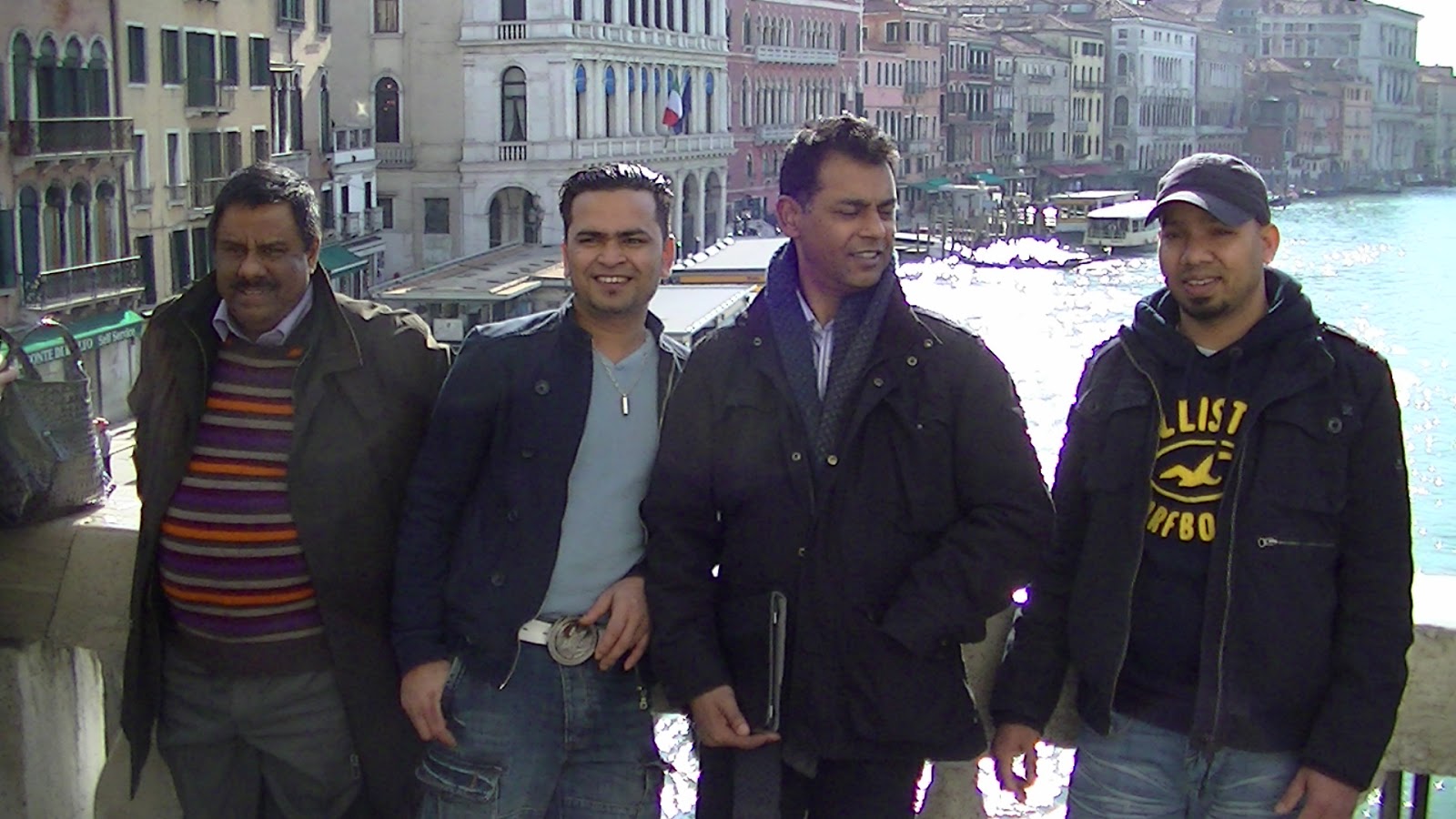
On the recent Taste of Britain Curry Festival in Slovenia, we took a cultural trip to Venice to savour its wonderful architecture, scenic waterways, romantic atmosphere … and pizza.


Venice is not renowned for pizza; in fact it’s not even a typical Venetian dish, but a trip to Italy’s most romantic city wouldn’t be complete without sampling the food so loved all over the world. And we were hungry!


Pizza actually originated in the south of Italy, in Naples, when resourceful inhabitants decided to jazz up their leavened or unleavened flatbreads by adding garlic, lard, salt or cheese and, (after they were introduced into the country in 1548), tomatoes.


Today, pizza making is a profitable business – Italians eat over three billion of them a year. But according to recent reports, native Italians are shunning the traditional role of pizzaiaoili or pizza maker because of the long hours and hard work involved. Instead, the gap is being filled by the country’s immigrant workers who have more motivation and many of the cooks in Italy’s 25,000 pizzerias now hail from Egypt, Bangladesh or even the Ukraine.


Whatever nationality, we found there were still plenty of chefs to man the hundreds of takeaways, pizzerias or simple hole-in-the-wall outlets that form part of almost every street and piazza of Venice. Wandering from the station, through narrow streets, lined with shops, window boxes and washing, our stomachs were set rumbling by fragrant smells emanating from wood burning stoves. Inside shops pizzaioili stretched uncooked balls of leavened dough by hand or with a rolling pin, sometimes performing air acrobatics with the discs for the entertainment of passers-by.  The pizzas were gargantuan, in raised Neapolitan style or flat Roman, smothered in gorgonzola or mozzarella with artichokes and musky chorizo they adorned shop windows and tempted with their smiling rings of thinly sliced peppers and onions.  


As we were in the most beautiful city in the world we put our hunger on hold to admire the wonder of our surroundings. They were stunning. Venice is an island within islands – 118 of them to be precise - separated by canals and joined by 409 bridges. Not so many years ago the whole city was sinking and there were fears it would eventually disappear into the marshy lagoon in which it was built. Now, thanks to a ban on the Artesian wells which supplied local industry, the world famous buildings and precious art works are safe and visited by thousands of tourists every year.


The city is made for strolling and part of the joy of a visit to Venice is in soaking up the atmosphere. Eventually, and inevitably, we wound our way into the breathtaking Piazza San Marco, or St Mark’s Square. Flanked by the Basilica di San Marco, a great dome shaped church and the Doge’s Palace, the Square is also populated by thousands of tame pigeons which provide hours of amusement for tourists (and chefs). In the famous CaffĂ© Florian, established in 1720, we paid the equivalent of a small ransom for a coffee but it was worth it to take in the delights of the piazza, listen to the small orchestra play, and watch the elegance of the aperitivo or promenade taken by Italians to see and be seen.


At the evocatively named Bridge of Sighs under which prisoners used to go on their way to and from the courts and prisons, the Grand Canal opened out before us. The busiest waterway in the city has all the movement, light and colour of a Canaletto painting. Three bridges cross the Grand Canal, the most famous being the Rialto built in 1588 with its double row of shops selling souvenirs, gold and Venetian carnival masks. A gondola ride, particularly a serenaded one, would have been the ultimate in romance but was, sadly, matched in price. The next best thing, a traghetto; is a similar vessel but one in which passengers have to stand, balancing precariously as they cross the waterway. A cheaper and more stable option is humble waterbus, or vaporetto which takes passengers on a fascinating journey away from the tourist hot spots along the back routes of the city.


At the Bacaro lounge in San Marco, gondoliers join the chic and trendy to eat, piatto del giorno (or plate of the day) priced from ten euros.  If we hadn’t had our sights set on pizza, more, typical Venetian recipes served in traditional restaurants include Sarde in Saor – sweet and sour sardines or Risotto di Zucca; risotto with pumpkins, onion and parmesan cheese. The local pasta is bigoli; a thick and coarse spaghetti sometimes black when mixed with squid ink, seasoned with fish or game sauces.


As for pizza, there were endless possibilities. In the Arte della Pizza, a hole in the wall restaurant off the Strada Nova, a huge pizza cost around six euros; or at Ae Oche in the Santa Croce area, we could have chosen from 90 types of wood-fired pizzas. All’Anfora on Lista Bari offered a plethora of traditional pizzas loaded with local tasty produce. Near the Rialto Bridge, the Muro restaurant specialised in calzone, and cicchetti (tapas) while the Antica Birraria la Corte on Calle S Bernando, a former bull fight pen, served up traditional pizzas with arugula, bresaola – a salted, seasoned aged beef - and Grana Padana.


Unfortunately, all we can only imagine how wonderful all these were. In desperation we satiated our hunger at a rather touristy restaurant behind St Mark’s Square where the immigrant pizza makers served up a bland Capricciosa pizza, and a coke at five euros a can. After feasting our eyes on so many varieties, it was, admittedly, a slight anticlimax. But eating the world’s most popular food in its home country and in the most beautiful city in the world was an experience to be savoured forever and anyway, now that the city’s no longer sinking, there’ll always be a next time.

 
The Curry Life Team stayed at Hotel Park, Ljubljana Tabor 9, 1000 Ljubljana, Slovenia
Phone:+386 1 300 25 00


Thursday, 22 August 2013

Curry Comes Home at Taste of Britain Curry Festival in Pune


Curry Life took a team of top chefs over to Pune in India to take part in The British Curry Festival. We take a look at how the great British curry went down back on the Indian subcontinent.

For ten years now, Curry Life magazine has been showcasing the talents of British based Bangladeshi and Indian chefs in many different countries including the Indian subcontinent where curry had its birth.

Visitors to Curry Life festivals in India and Bangladesh are always curious about the British curry industry and how Chicken Tikka Masala has won over the hearts and taste buds of diners in a country renowned for the blandness of its cuisine. But curry and Indian food in the UK is literally a world away from how it is back on the subcontinent. Adapted to suit the timorous British palate and fresh, locally sourced ingredients, British curry has gained an identity of its own. The question is – how does the Anglicised version compare with its Indian counterpart? Has it become (dare we say) even better? And can our chefs now teach the Indian people a thing or two about making curry?

The answer, it would seem is that they can - the latest conquest of the great British curry took place in November 2012 when Curry Life Magazine jetted a team of selected chefs over to the Hotel Hindustan International in the Maharashtrian city of Pune near Mumbai.

The culinary masters hailed from some of the finest Indian restaurants in the UK: Chef Abul Monsur of Taj Cuisine in Chatham; Chef Allam Shah Ullah of Cutler’s Spice in Sheffield, and Kaysar Ahmed of Zeera in Potters Bar, led by master chef and festival veteran Partha Mittra of The Snooty Mehmaan in Oxfordshire. The four pooled their talents to create a buffet of fifty quintessentially British curry dishes for the local diners. In addition to the tried and trusty fare so loved by the UK public (including the ubiquitous Chicken Tikka Masala), citizens of Pune could indulge in more exotic recipes like Fish Balti Exotica, Nimbu Chicken with honey glazed carrots, Shatkora Chicken and Chana Aloo Gratin.
 

Not only did the festival curry favour for the chefs in their home towns, but, coinciding, as it did, with a new explosion of interest in international food on the subcontinent, members of the Indian press flocked to the launch event. It would seem that westernised tastes are becoming more popular in India. The cities of Mumbai, Delhi and Bangalore are seeing new restaurants opening up every month, many started by foreign entrepreneurs who tempt Indian diners with foods they have never tasted before. In this climate, the concept of bringing British curry dishes back to India could be seen as a potential crowd puller.

Festival organiser Syed Belal Ahmed explained: “There is an appetite for British curry despite the vast range of indigenous cuisine on offer in the subcontinent. British curries are unique – they are much milder and healthier. When we take our Balti dishes from the UK to India there is always a buzz in the media– everyone wants to try these.”


“People in India and Bangladesh are always surprised by the fact that Indian restaurants are now found in abundance in every British city and town,” said chef Abul Monsur. “They are curious about why curry has become so popular and tasting British-Indian fusion dishes prepared by chefs who have actually come over from the UK gives them a chance to find out why.”


Diners, initially sceptical as to whether the Anglicized version of curry could be as tasty as Indian specialties were for the most part, won over by the new flavours and healthy cuisine. Allam Shah Ullah who owns the Gleadless Town End restaurant Cutler’s Spice was surprised at how well his dishes went down with the locals: “They seemed to love the fact that we keep our vegetables crunchier and our meat off the bone,” he said, “Many commented on how tasty and fresh the food, although some said they were not as hot as the Indian versions.”

“The way curry is made is different over here,” explained Partha Mittra, one time chef to a former Indian Prime Minister. “We use fewer spices and many of them are European herbs. The sauces and gravies are creamier and sweeter and a lot less oil and butter is used so the British version is often healthier.”

 Kaysar Ahmed, whose dishes included prawns cooked in wine with broccoli and cheese agreed: “Our British curries are made with fresh English herbs like mint, tarragon and basil and rosemary. They give a recognisable Western taste that suits the British palate. We also use olive oil instead of fully-saturated vegetable oil because it contains less fat and we cut down on salt and sugar in our preparations for the curries to be healthier. We also often serve salads as a side dish.”

And in a country where diabetes has the highest prevalence in the world and cardiac disease is on the up, healthy eating is becoming more and more of a priority for upwardly mobile Indian people. The festival might even have set a precedent for bold entrepreneurs to start up a restaurant on South Asian soil specialising in curry with a British twist.

Throughout the festival, diners and were guided by the chefs who were only too happy to explain the subtle differences in flavour in the fusion dishes. But it was not only an opportunity to show off British/Indian cuisine. When it was time to go home, all four chefs said the experience had taught them a lot about cooking methods and ingredients used in dishes in India and agreed they would use their new knowledge to create exciting dishes for customers in their own restaurants. 

“The main aim of the British Curry Festival is to foster the British chefs’ leadership role in the evolution of curry to meet the demands of the increasingly discerning taste of British food enthusiasts,” said the co-organiser of the festival, Syed Nahas Pasha. “But we have found that an increasingly important side product is of promoting British Bangladeshi/Indian chefs and cuisine all over the world. That is especially rewarding when it happens in the place where curry was born.”


Participating chefs: Abul Monsur, Taj Cuisine, 1 Sherwood House, Walderslade Centre, Chatham, Kent  ME5 9UD Tel: 01634 68668; Allam Shah Ullah, Cutler’s Spice, 1 Leighton Road, Sheffield, South Yorkshire Tel: 0114 241 6868; Kaysar Ahmed,Zeera, 5 Southgate Road, Potters Bar EN6 4DR Tel: 0170 643778; Organising Chef: Partha Mittra, The Snooty Mehmaan, Littleworth, Farringdon, Oxfordshire SN7 8PW Tel: 01367 242260